Chinese Imperial Edicts Explained
Having watched so many Chinese period dramas and the countless Imperial Edicts and Decrees being issued, do we really know what it means and why it is law and can’t be defied? This post explains everything you need to know about Imperial Edicts to help us enjoy our dramas even more.
What Is an Imperial Edict?
An imperial edict was an official document issued in the emperor’s name, the highest form of written command in the empire. It wasn’t just an announcement, it carried the full legal force of the emperor’s will, which meant defying one wasn’t simple disagreement, it was defiance of the throne itself.
Who actually put it together: despite being “in the emperor’s name,” most edicts weren’t personally handwritten by the emperor. They were drafted by court bodies, the Grand Secretariat, the Hanlin Academy, or similar institutions depending on the dynasty, then reviewed before being finalized.
Once that draft was approved and stamped with the imperial seal, and formally proclaimed, it became binding, regardless of who physically wrote the words.
What edicts were actually used for, since the term covers a wide range of official business, not just dramatic death sentences:
Appointing, promoting, demoting, or executing officials, probably the most common edict type you’ll see referenced in political-intrigue-heavy dramas.
Establishing new laws or policy changes.
Declaring war, peace, or granting amnesty.
Handing out rewards, titles, or land grants, the kind of edict that shows up when a character suddenly gets elevated in rank.
Responding formally to memorials, the written petitions and reports officials would submit to the throne.
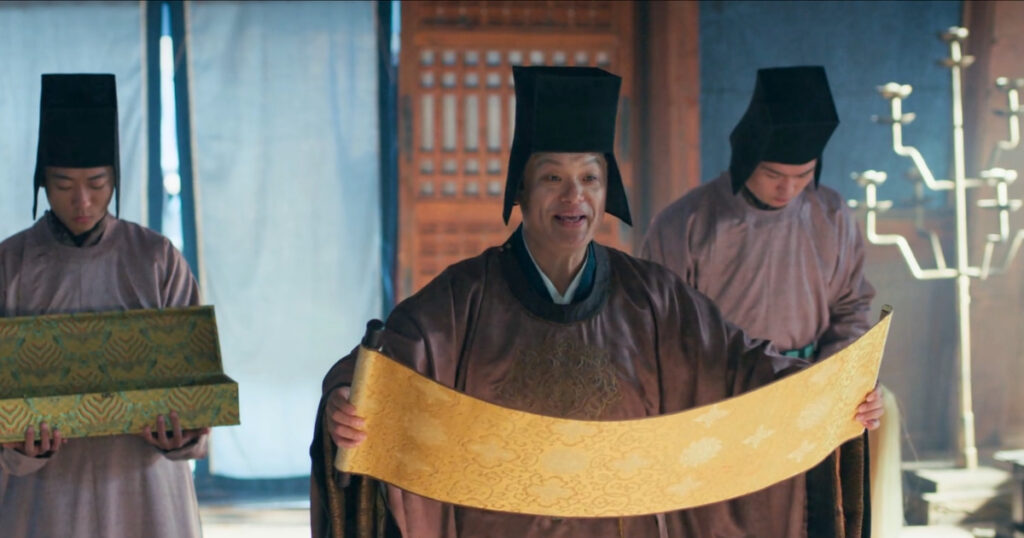
What it actually looked like: the visual most viewers will already recognize from dramas is accurate, a yellow, or sometimes white or silk, scroll, marked with a large red imperial seal. The physical object mattered as much as the words on it, since the seal was what proved authenticity, not a signature.

The Ceremony of Delivery and Acceptance
Receiving an imperial edict wasn’t just paperwork. It was a full, formal ritual, and every part of it existed to make one thing unmistakably clear: this wasn’t a message from a person, it was the emperor’s will made physically present in the room.
The messenger wasn’t just a courier, he stood in for the emperor himself. Usually, a eunuch or a specially appointed court official, whoever carried the edict was, for the duration of the ceremony, treated as an extension of the throne.
That’s the key detail that explains everything else about how seriously this was taken, refusing to properly receive the messenger was functionally the same as refusing the emperor directly, even though the emperor himself was miles away in the palace.
The kneeling itself had levels, and the full version was intense. Basic kneeling was the minimum expected response, but for the most significant edicts, the ritual escalated to the full kowtow, three kneelings, each followed by three knocks of the head to the ground, nine head-knocks total.
This wasn’t a quick, symbolic gesture. It was a deliberately drawn-out physical act of submission, performed in front of witnesses, precisely because the visibility of it was the point.
It wasn’t enough to privately accept an edict’s authority; you had to publicly perform that acceptance in a way everyone present could see and later attest to.

Nobody was exempt, and that was the whole point. Even the highest-ranking ministers and princes, men who held real power and status in every other context, dropped to their knees the same as anyone else when an edict arrived.
That’s not a small detail, it’s actually the mechanism doing the work here. The ritual wasn’t really about the specific content of any one edict, it was a recurring, physical reminder threaded through the entire social hierarchy that no rank, however senior, sat above the emperor’s authority. Every kneeling was a small, repeated reinforcement of where everyone actually stood.
And it wasn’t optional theatre, it was enforceable. Performing the ritual incorrectly, hesitating, kneeling improperly, showing visible reluctance, could genuinely be reported as an act of disrespect toward the throne, and that report could carry real consequences.
This is worth flagging clearly for your readers, since it’s an easy detail for a drama to flatten into pure spectacle. In reality, this was closer to a legally and politically loaded performance than a dramatic flourish, the stakes behind getting it right were genuinely serious, not just visually impressive.

For your Edicts in Cdramas: Fact vs Drama section later, this is probably worth a callback: when a show has a character defiantly refusing to kneel for an edict, that’s rarely just a personality beat, it’s meant to register as a genuinely dangerous, borderline treasonous act, even if the visual is often played more for tension or drama than the writers spell out explicitly.
Why Edicts Could Not Be Contested
To understand why nobody argued with an edict once it was sealed and proclaimed, you have to understand what the emperor was actually claimed to be, and it goes well beyond politics.
The emperor wasn’t just the most powerful person in the empire, he was cosmically sanctioned. He held the title “Son of Heaven” (天子), and under the political and cosmological framework that shaped Chinese thought for roughly two thousand years, he ruled by the Mandate of Heaven (天命).
That’s the detail that changes everything about how an edict functioned. His word wasn’t simply a political decree that people were too afraid to challenge, it was treated as an expression of a cosmic order, meaning disagreeing with it wasn’t just risky, it was framed as disagreeing with the structure of the universe itself.
Which is why challenging an edict wasn’t treated as disagreement, it was treason. Opposing an edict meant opposing the emperor directly, and that put you into genuinely severe legal territory, the kind of charges translated as “great treason” (大逆) or “plotting rebellion” (謀反). These weren’t minor offences with room for negotiation, they were among the most serious crimes on the books.
And there was no independent court to appeal to. This is worth sitting with for a second, because it’s a genuinely different system from what a modern viewer would assume. There was no separate judiciary empowered to check or overrule the emperor.
The entire legal system existed specifically to enforce his will, not to act as any kind of counterbalance to it. So the option a modern audience might expect, “take it to court,” simply didn’t exist in this structure.
There was one legitimate window for disagreement, but it closed fast. Officials could remonstrate, formally advise or protest, before an edict was actually issued, and some genuinely brave ones did exactly that, fully aware of the personal risk involved in pushing back on the emperor’s intentions.
But that window closed the moment the edict was sealed and proclaimed. Once it was official, open resistance stopped being risky and became almost always fatal.
What actually happened when an official disagreed after the fact: in practice, the clever ones didn’t confront the emperor directly, because that essentially never worked out well for them.
Instead, they’d quietly delay implementation, reinterpret the wording in a more favourable direction, or find ways to undermine an edict without ever appearing to defy it outright. What almost never happened, and this is the detail worth building into your Fact vs Drama section later, is a dramatic, direct “this is wrong, and I refuse,” delivered to the emperor’s face.
Dramas love that confrontation because it’s great television, but it’s closer to fantasy than historical practice. Real resistance was quiet, indirect, and deniable, because open defiance simply wasn’t survivable.