Shichen; How Ancient China Named Their Hours
How many times have you watched a Chinese period drama and you get confused with how they are referring to time? In Ancient China, they named their hours differently and this post helps to break it down.
The Basics
Forget 24 hours. Ancient China ran on a 12-hour day, called shichen (时辰). Each shichen covers exactly two of our modern hours, and instead of numbers, each one was named after a zodiac animal, the same twelve used in the Chinese zodiac year cycle.
Where the System Anchors
The whole thing is built around solar noon, the exact moment the sun hits its highest point in the sky. That moment marks the dead centre of the Horse hour. Once that’s fixed, the other 11 shichen fall into place symmetrically around it.
And here’s a fun detail: the calendar day doesn’t start at dawn like you might expect. It officially starts at the exact centre of the Rat hour, which is midnight.
The 12 Hours, By Animal and Activity
| Shichen | Animal | Modern Time | The Vibe |
| Zi (子) | Rat; foraging | 11pm – 1am | Midnight peak, the dead of the night |
| Chou (丑) | Ox; chewing cud | 1am – 3am | Deep night |
| Yin (寅) | Tiger; hunting | 3am – 5am | Pre dawn, sky just starting to lighten |
| Mao (卯) | Rabbit | 5am – 7am | Sunrise; start of working day |
| Chen (辰) | Dragon; brining rain | 7am – 9am | Morning, breakfast |
| Si (巳) | Snake | 9am – 11am | Late morning |
| Wu (午) | Horse | 11am – 1pm | Solar peak, midday |
| Wei (未) | Goat; grazing | 1pm – 3pm | Afternoon |
| Shen (申) | Monkey | 3pm – 5pm | Late afternoon; second meal |
| You (酉) | Rooster; home | 5pm – 7pm | Sunset, work day winding down |
| Xu (戌) | Dog; on guard | 7pm – 9pm | Dusk |
| Hai (亥) | Pig; resting | 9pm – 11pm | Early night, settle in for the night |
Splitting Each Hour in Half
Each two-hour shichen actually breaks down into two one-hour halves, for a bit more precision:
- Chu (初), the “initial” half. For the Rat hour, that’s 11pm to midnight.
- Zheng (正), the “central” or peak half. For the Rat hour, that’s midnight to 1am.

The Five Night Watches (Geng)
While shichen ran continuously, non-stop through the whole day and night, the hours of darkness got a second, separate layer of tracking laid on top: the five-night watches, called geng (更). This system existed specifically to cover the night, roughly 7pm to 5am, and it’s what you’ll hear referenced whenever a period drama mentions “third watch” or has watchmen striking a drum or gong somewhere in the background of a night scene.
The five watches, roughly mapped to modern time and shichen:
First Watch (一更), around 7pm to 9pm, overlapping with the Dog hour. This is early evening, households winding down, gates starting to close for the night.
Second Watch (二更), around 9pm to 11pm, overlapping with the Pig hour. Most ordinary people would be asleep or heading to bed by now.
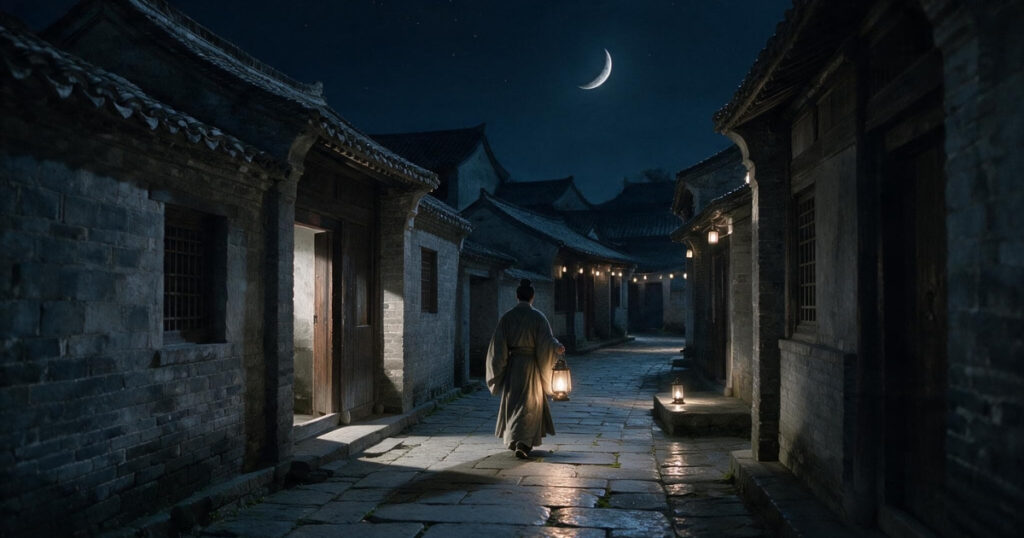
Third Watch (三更), around 11pm to 1am, overlapping with the Rat hour. This is the deepest, quietest point of night, and it’s why “third watch” shows up constantly in period dramas as the backdrop for secret meetings, assassinations, and anything characters don’t want witnessed.
Fourth Watch (四更), around 1am to 3am, overlapping with the Ox hour.
Fifth Watch (五更), around 3am to 5am, overlapping with the Tiger hour. This is the final stretch before dawn, often associated with roosters starting to crow and the household beginning to stir.
How it actually worked in practice: watchmen patrolled the streets or the walls of a residence through the night, and at the start of each new watch they’d sound a drum or strike a gong a specific number of times, once for the first watch, twice for the second, and so on, so anyone awake could tell roughly how far into the night it was without needing to see the sky.
This served two purposes at once: it functioned as a public announcement system before clocks existed, and it doubled as a genuine deterrent against thieves, since a patrol calling out the hour was also a patrol actively walking the grounds.
The seasonal complication worth mentioning: unlike shichen, which are always a fixed two hours regardless of the time of year, the five watches were meant to evenly divide the actual hours of darkness, and darkness isn’t the same length every night.
A summer night might only need to stretch the five watches across seven or eight hours, while a long winter night could stretch them across ten or more. This meant the watches didn’t line up with the same fixed clock times year-round the way shichen did, and historically this required constant recalibration using water clocks to keep the system accurate as the seasons shifted.
The Ke System (刻)
Alongside shichen for the hours and geng for the night watches, there was a third layer of timekeeping: the ke (刻), which divided the entire day into 100 equal units rather than 12 or 5.
Why a separate system existed at all: shichen and geng were built for every day, human-scale references, meeting times, watch changes, that kind of thing. But for anything requiring real precision, timing a ritual, coordinating an official ceremony, running a water clock accurately, 12 broad two-hour blocks weren’t nearly granular enough. The ke system existed to fill that gap.
The math, and why it’s a little messy: a full day was divided into 100 ke. Since a day has 1,440 minutes, that makes one ke exactly 14.4 minutes. The awkward part is that 100 doesn’t divide evenly into 12, so ancient astronomers had to work out a precise conversion between the two systems: one shichen equals exactly 8 ke and 20 fen, with fen being a smaller sub-unit, each one equal to about 12 seconds.
So a single shichen wasn’t a clean, round number of ke, it was 8 and a fraction, which meant real mathematical coordination to keep the two systems aligned.
How it was actually measured: this is where the water clock, or clepsydra, comes in. A water clock worked by letting water drip at a steady, calibrated rate from one vessel into another, marked with graduated lines.
As the water level rose or fell, an official could read off the current ke with real precision, day or night, regardless of cloud cover, which a sundial simply couldn’t manage.
This made the ke system the preferred method for palace and government timekeeping specifically, where consistent, verifiable accuracy actually mattered, as opposed to the more casual, sky-and-drum-based shichen and geng systems used by ordinary people.
Why it’s genuinely useful for a viewer: this is the system behind that classic dramatic phrase you’ll hear in court or execution scenes, something like “you have until the third ke of the Hour of the Horse,” which sounds vague and ceremonial in subtitles but was actually a specific, measurable deadline, accurate to within about 14 minutes.
It’s less poetic flourish and more a countdown clock, which honestly raises the tension of those scenes once you know what’s actually being said.

Why This Actually Matters When You’re Watching
Once you know this system, a lot of dialogue in period dramas stops sounding like vague poetic flourish and starts making literal, practical sense.
When a character says “meet me at the Hour of the Rat,” that’s a precise instruction, somewhere between 11pm and 1am, not mysticism. It’s the equivalent of someone today saying “meet me at midnight,” just dressed in older language.
Once you know the animal-to-time mapping, half the seemingly cryptic scheduling in period dramas turns out to be perfectly ordinary logistics.
It also explains why executions and major court proceedings so often happen at “Wu shi,” the Hour of the Horse. That’s the brightest point of the day, when yang energy was believed to be at its peak, making it the most auspicious time to carry out something as serious as an execution without inviting bad luck or vengeful spirits.
This wasn’t just superstition either, it was baked into actual legal procedure for a long stretch of Chinese history, official executions were scheduled specifically around this window because timing was considered part of getting the ritual right, not incidental to it.
A few more you’ll start noticing once you know what to listen for:
Secret meetings, ambushes, and anything characters don’t want overheard tend to cluster around the Rat and Ox hours, the deepest, quietest part of the night, when almost no one else is awake to witness it. That’s not a coincidence either, it’s the writer using the setting itself to signal danger before anything happens on screen.
The Rooster hour, sunset, shows up constantly as the backdrop for farewells, departures, and bittersweet goodbyes. There’s a reason for that too, it’s the natural hinge point of the day, work ending, people heading home, which makes it an easy visual shorthand for endings in general.
And court scenes, official announcements, and anything meant to carry weight and formality skew toward the Snake and Horse hours, late morning into midday, which lines up with when government business was actually conducted historically, rather than being an arbitrary directorial choice.
Once this clicks, you start watching period dramas slightly differently. A throwaway line about the hour isn’t just flavor text, it’s the writers quietly telling you how to feel about a scene before it even unfolds, danger, farewell, formality, all coded into a single word you’d otherwise skim right past.