Marriage Rituals in Ancient China
Some of the best scenes in period Chinese dramas are the wedding scenes. The costumes are always so elaborate and the ostentatious marital red provide such amazing visuals. Get to know the traditions for the wedding process in Ancient Chinese times to better appreciate the dramas.
How Marriage Actually Worked (The Basics)
Marriage in ancient China was not mainly about two people falling in love and choosing each other. It was an arrangement between families, and it carried real social and ancestral weight. Weddings ranked among the traditional “Four Great Joys” of life for a reason: the purpose stretched far beyond the couple themselves. Marriage forged or strengthened alliances between households, ensured the continuation of the family line, and fulfilled duties to the ancestors.
In this patriarchal system, personal choice, especially for women, played only a limited role. Most matches were arranged by the parents, often with little or no say from the bride or groom. The entire process followed a formal, carefully codified set of rituals that can be traced back roughly three thousand years to the Zhou dynasty.
Matchmakers and the Art of the Proposal
Direct courtship wasn’t really how this worked. Marriages typically moved through a matchmaker (媒人), a third party who handled communication, negotiation, and vetting between the two families rather than the prospective couple approaching each other directly. This wasn’t just a formality either, matchmakers played a genuinely central role in assessing whether a match made sense socially, financially, and astrologically before the families committed to anything.
The Six Rites (六礼)
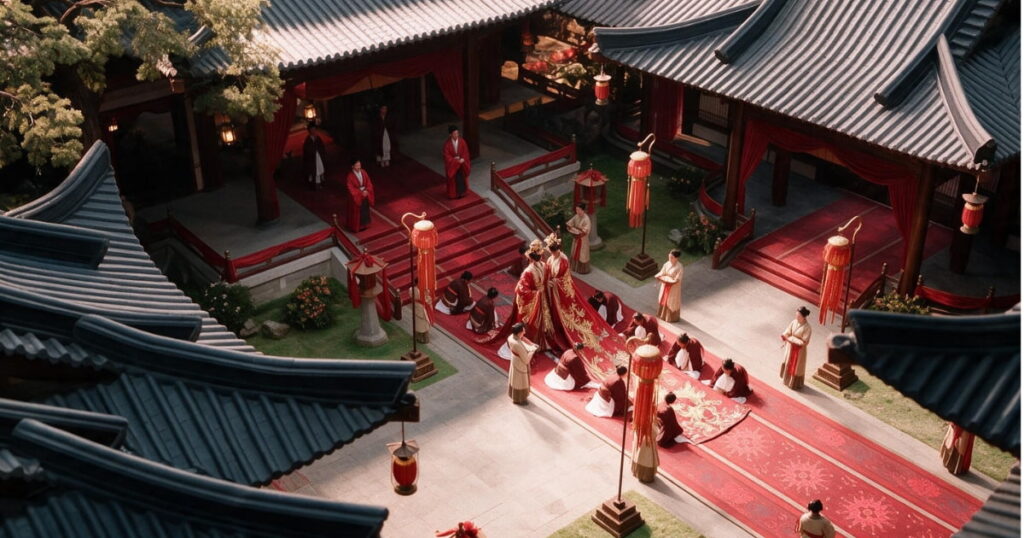
This is the actual backbone of the whole process, a sequence of six formal steps first recorded in the Book of Rites and standardized during the Zhou dynasty. Later dynasties adjusted the specifics, but the six-step structure stayed remarkably consistent for centuries.
Nacai (纳采), the Proposal. The groom’s family, through the matchmaker, sent gifts to the bride’s family to formally propose. A wild goose was a traditional gift here, chosen specifically as a symbol of loyalty, since geese were believed to mate for life.
Wenming (问名), the Name Inquiry. The matchmaker requested the bride’s name and birth date, information needed for the next step.
Naji (纳吉), the Auspicious Announcement. The groom’s family took the bride’s birth information to a diviner to check for compatibility. If the signs came back favourable, the families were formally notified, along with more gifts.
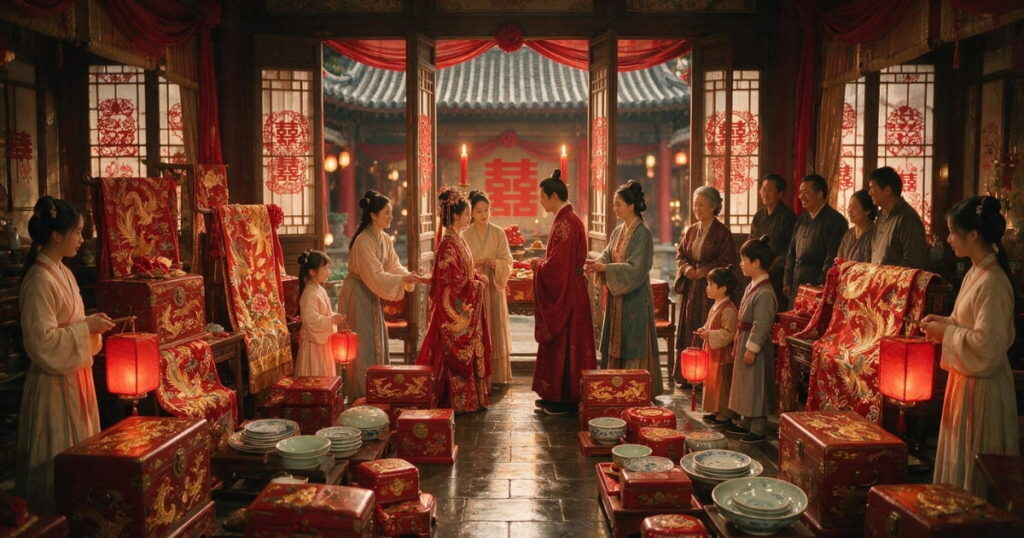
Nazheng (纳征), the Betrothal Gift Presentation. This was the big one, the formal, substantial betrothal gift that locked in the engagement itself. Once this step happened, the marriage was considered socially binding.
Qingqi (请期), Requesting the Date. The groom’s family selected an auspicious wedding date and formally sought the bride’s family’s approval for it.
Qinying (亲迎), Fetching the Bride. The groom personally travelled to the bride’s home to bring her back for the wedding ceremony itself, the final step that completed the process.
Worth noting for your Fact vs Drama section later: the full six-step version was genuinely elaborate and, especially in later dynasties, often streamlined into a simpler three-step process in practice, since the complete ritual was demanding even by the standards of the people who created it.

Matching Horoscopes and the Zodiac
The “naji” step deserves its own spotlight, because dramas reference it constantly without always explaining what it means. Checking a couple’s compatibility meant comparing their “bazi”, the Four Pillars of Destiny based on their exact birth details, mapped against the Chinese zodiac and traditional astrology, to decide whether the match was auspicious.
If the reading came back unfavourable, it could stop a proposed marriage cold, no matter how well the two families otherwise got along. Going ahead with a poorly matched union was believed to invite misfortune on both households.
Betrothal Gifts and the Bride Price
The betrothal gifts exchanged at the “nazheng” stage were not symbolic tokens. They were substantial, and what counted as appropriate changed across dynasties. In the Zhou period, the traditional offerings were silk and deerskin. Later eras shifted toward gold, silver, and finer silks.
Gifts were almost always presented in even numbers, since even numbers were considered auspicious and linked to good fortune. The exchange itself served as a clear, public signal of the groom’s family’s sincerity and financial standing, while also locking in the social and material obligations both sides were now taking on.
The Wedding Day Itself
This is where most of the imagery cdrama viewers will already recognize comes from. The bride travelled to the groom’s home in a red bridal sedan chair, and red dominated the entire event, symbolizing luck, joy, and protection against misfortune.
Along the way and during the ceremony, several ritual acts were performed specifically to ward off bad luck and invite blessings, including a “crossing the fire basin” ritual the bride would step over or past, a symbolic cleansing act before entering her new home.
Since the Tang dynasty, couples also performed a hair combing ceremony, where each would take a strand of the other’s hair and bind them together into a single knot, a direct, physical symbol of their union.
The couple would drink nuptial wine together as part of the ceremony, and once they entered the bridal chamber, it was common for dates and peanuts to be scattered around, a wish, through wordplay and symbolism, for early and plentiful children.

Joining the Husband’s Family
Once married, the bride moved into her husband’s household—not the other way around—and this was no minor logistical detail. It completely reshaped her social position.
In this patriarchal system, a woman had limited autonomy both before and after marriage. Her incorporation into her husband’s family—answering to his parents and adapting to his household’s customs—was one of the defining, recurring realities of the entire marriage system.
That is also why so much weight was placed on formal documentation and ritual correctness. Historically, a marriage carried out without the proper written records and rites could be regarded as socially or legally irregular.

Marriage Rituals in Cdramas: Fact vs Drama
A lot of what shows depict is grounded in something real: the matchmaker, the red sedan chair, the astrological compatibility checks, the elaborate betrothal gift exchanges, all genuinely accurate to the historical practice.
Where dramas tend to compress things is time and formality, showing a proposal-to-wedding arc play out over a few dramatic scenes, when in reality this six-step process, with its rounds of gift-giving, divination, and formal approval at each stage, could stretch out over a considerable period.
Dramas also love the dramatic, last-minute “I refuse to marry him” moment right before the ceremony, which, given how binding and socially entangled the process was by the time it reached the wedding day itself, would have been an almost unthinkable act of defiance in reality, not a realistic late-stage plot twist.


